笔记一
笔记源自 RegexOne
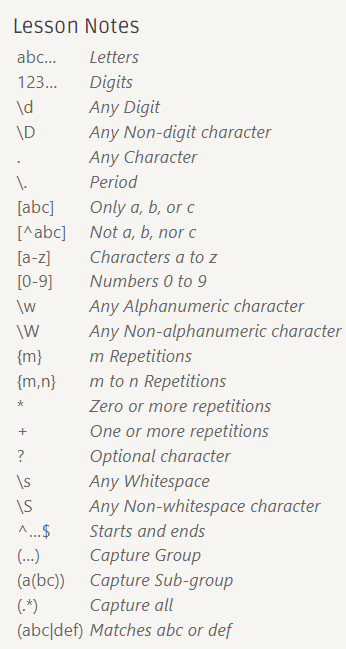
需要转义的特殊字符:
* . ? + $ ^ [ ] ( ) { } | \ /
\s匹配所有空格字符,等同于: [\t\n\f\r\p{Z}]\f换页符\n换行符\r回车符\t制表符\p等同于\r\n, CRLF DOS 行终止符
Notes
非捕获组:
(?:...): 匹配字符但不创建捕获组
下面的笔记源自 github 正则表达式教程
4. 零宽度断言
正先行断言 (positive lookahead):(?=...),匹配位置的后面有指定模式
负先行断言 (negative lookahead):(?!...),匹配位置的后面没有指定模式
正后发断言 (positive lookbehind):(?<=...) 匹配位置的前面有指定模式
负后发断言 (negative lookbehind):(?<!...) 匹配位置的前面没有指定模式
比如对于字符串 foobarbarfoo
bar(?=bar)     finds the 1st bar ("bar" which has "bar" after it)
bar(?!bar)     finds the 2nd bar ("bar" which does not have "bar" after it)
(?<=foo)bar    finds the 1st bar ("bar" which has "foo" before it)
(?<!foo)bar    finds the 2nd bar ("bar" which does not have "foo" before it)
(?<=foo)bar(?=bar)    finds the 1st bar ("bar" with "foo" before it and "bar" after it)
5. 标志
/pattern/flags, 其中 flags 有:
- i 忽略大小写。
- g 全局搜索,返回全部匹配。
- m 多行修饰符:锚点元字符 ^ $ 工作范围在每行的起始。
6. 贪婪匹配和惰性匹配
默认是贪婪匹配,使用?转化为惰性匹配。
"/(.*at)/" => The fat cat sat on the mat.
"/(.*?at)/" => The fat cat sat on the mat.